About Us
Our Businesses
Investors
Responsibility

Media

Careers

About Us
Our Businesses
Investors
Responsibility
Media
Careers

Our businesses are united by our purpose to provide safe, nutritious and affordable food.
 Quality assurance inspection, Allied Mills, Manchester, UK
Our food and drink businesses operate quality management systems based on the WHO Codex Alimentarius Hazard Analysis Critical Control Point (‘HACCP’) principles and the Global Food Safety Initiative (‘GFSI’) range of standards, with most retailer-facing businesses required to seek formal GFSI certification, typically via unannounced audit schemes. Additionally, each division, as a minimum, sets and monitors a range of KPIs for each of its sites, including in relation to recalls and withdrawals, incidents and complaints.
These KPIs are reported to the Board on an annual basis, and any themes identified are relayed to the cross-business Product Risk Reduction Group for review and resolution. To help navigate the ever-changing food law landscape, all divisions have access to a food law specialist within the Group legal team.
Each division employs staff to assure the safety, quality, legality, integrity and authenticity (Vulnerability Assessment and Critical Control Points) of both raw materials and finished products. Raw material approval format is dependent on the risk posed but will typically comprise vendor assessment by audit or questionnaire, supplier certification review and product testing.
At site level, HACCP outcomes and Good Manufacturing Practice determine the scope of quality assurance and quality control regimes. To continually improve site practices, structured food safety and quality culture programmes are in place. Threat Assessment and Critical Control Points protocols covering supply chains and site activities to counter malicious intent are also in place. All of the above regimes are subject to ongoing verification and validation activities.
Relevant businesses take nutritional factors into account across their product portfolio. Many of our food products already support healthier choices, from high-fibre breakfast cereals, wholemeal bread and crispbreads to specialist sports nutrition products. Product reformulation can help to gradually shift consumer tastes towards foods that support better long-term nutrition, and our food businesses actively review their portfolios with this in mind.
Making Sense of Sugar is ABF Sugar’s global platform dedicated to providing access to factual information and finding collaborative solutions to health challenges, as part of its commitment to thriving and healthy communities. The platform is live in Malawi, Tanzania, Zambia, Spain, the UK and Latin America, where it aims to inform and educate people about sugar and the role it can play as part of a healthy, balanced diet.
We have a Group policy laying out our approach to genetically modified (GM) ingredients, including compliance with local regulations on their use and the labelling of GM ingredients. Grocery Group continues to work closely with the UK’s Food and Drink Federation (‘FDF’), participating in industry-wide programmes designed to deliver meaningful health benefits to consumers. Ryvita, Jordans Cereals and Kingsmill remain signatories to the FDF’s Action on Fibre, an initiative to increase fibre consumption in the UK by helping to close the shortfall between the recommended daily fibre intake and current national consumption levels.
In Australia and New Zealand, George Weston Foods’ businesses Tip Top and Yumi’s support clear food labelling practices to help consumers make informed choices. Both businesses actively participate in the voluntary Health Star Rating front-of-pack labelling system.
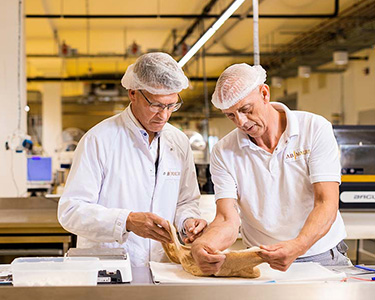
 An application development technologist inspects bread rolls at the AB Enzymes baking lab, Singapore